Saturday, July 16, 2011

Maccha-KakigoriーCool Dessert for the Dog Days of Summer

This is "Maccha-Kakigori"(抹茶かき氷).
This is Japanese shaved frozen dessert flavored with Green tea syrup in summer.
Greentea syrup is poured on top of it,(on the right side)
and left side is condensed milk.(white)
Toppings are adzuki beans and green tea ice cream,and white dumplings.
We enjoy this to fight the scorching heat of summer.

This shop is Kyoushouan(京匠庵).This is located near Kintesu Nara Station.

Wednesday, July 13, 2011

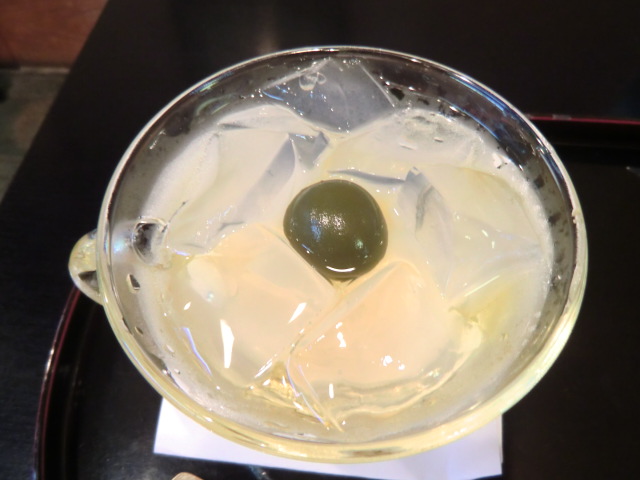
Summer sweets ーkudzu-warabi(葛わらび餅)

This is "kudzu-warabimochi".(葛わらび餅)
Topping(orange) is "yuzu"(柚子),an aromatic citron.
This is summer sweets,looks very cool.

I chose grape juice for set menu.
They're so cool, make me forget the heat.....

Saturday, July 9, 2011

Wakousha(和光舎)ーAtelier restoring ancient embroidery

Today I visit an interesting atelier in Kyoto.
This atelier specializes in restoring ancient embroidery of canonical robe.

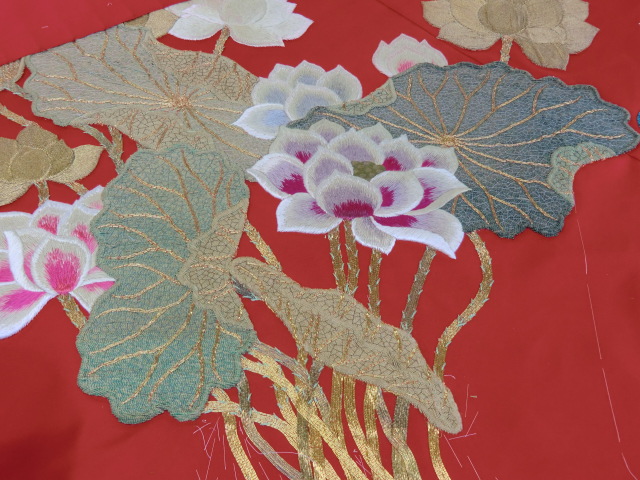
This is a lotus flower.
Lotus flower is closely related to Paradise,Heaven in Buddhism.
This is like real lotus flower...This is made with wonderful skill.
But artisans in this atelier do not create this from the very beginning.
Their work is to restore this kind of ancient embroidery.
These robes with embroidery are used in many temples in Kyoto,
and as years go by,these clothes and embroideries become old and damaged,
so they need to be restored.
That is why this repair shop is needed and relied on for many temples in Kyoto.
This is also lotus flower.
This is peony. In Buddhism,peony is also related to Paradise,Heaven.
Restoration of these embroideries is once in 10 or 20 years.
These flowers are so gorgeous and so realistic.
And these are not for Zen. This is important.
Zen motto is "modest,and simple,humble".
These embroidery are too gorgeous for Zen temple and Zen priest.
These embroideries are for "Higashi-Honganji" and "Nishi-Honganji".

This is a Chinese phoenix.
This is an imaginary bird.
Chinese phoenix is also related to Paradise,Heaven in Buddhism.
This bird spread its wings.
These wings are also very realistic,
I can see this bird flapping its wings a couple of times....Wow!
This is cherry blossoms.
I admire this delicate workmanship.
Originally,these way of embroidery came from India,and China about 1500 years ago.
And artisans in this atelier maintain this tradition.
They restore countless embroideries of canonical robes from many temples in Kyoto.
And this is Chinese lion.
This lion is three-dimensional.
This is technique of embroidery to make this lion as real as possible.
And his eyes.
The artisan of this atelier said,
"His eyes were damaged because of overage,
so we restored his eyes using glass."
And  his eyes are bloodshot,
this is also technique to make this lion real.
As you see,everything is restored with care in this atelier.
Embroidery of canonical robe in Japan has established for many years.
These techniques should be succeeded to future generation.

Monday, July 4, 2011

Maiko Kanzashi (舞妓 かんざし)

These pics below are postcards of Maiko.
Maiko changes their "Kanzashi"(long ornamental hairpin) every season.

In July,(this month),Maiko wears "Uchiwa" Kanzashi.
"Uchiwa" means "a round paper fan".

In August,they wears "Susuki" Kanzashi.
"Susuki"means "Japanese pampas grass".

In September,they wears"Kikyo"Kanzashi.
"Kikyo"means "a balloonflower".
And she's enjoying "a moon-viewing".

As you see,people in Kyoto always care about a sense of the season.
And Maiko express that by their Kanzashi.
I admire their sensitiveness to the seasons,and their hospitality.

Tuesday, June 28, 2011

Seien (栖園)-Sweets Cafe in Kyoto,Karasuma

From this outward appearance,who believes that this is "sweets cafe"...?
But this is cafe,"Seien" (栖園), since 1885.
That appearance is very tasteful...
This shop curtain, which is hung outside the entrance,is impressive.
This shop is located near Kyoto-Daimaru (Department Store) in Karasuma.

I ordered "Kohaku-Nagashi" (left) and "Zenzai"(right).

This is "Kohaku-Nagashi".
This dessert is like transparent jelly,and apricot is on it.
This dessert has an apricot taste,which is sweet and sour.
"Kohaku" means "amber".
This dessert is amber-colored,that is the origin of the name of this dessert.
This amber color comes from this apricot.
This is cool-looking summer dessert.
 
 This is "Zenzai", sweet red-bean soup with pieces of rice cake.
In summer,we enjoy cool Zenzai, and in winter,we enjoy hot Zenzai.
This is yummy...^ ^


And I bought these desserts for souvenir.^ ^
They are made in the shape of sweetfish,inside is a white bean jam.
Around the fishes,there are cute sweets...flowers,fruits,eggplant...
They're colourful and cute.

Friday, June 17, 2011

Hina-Ningyo (Takatori,Nara)

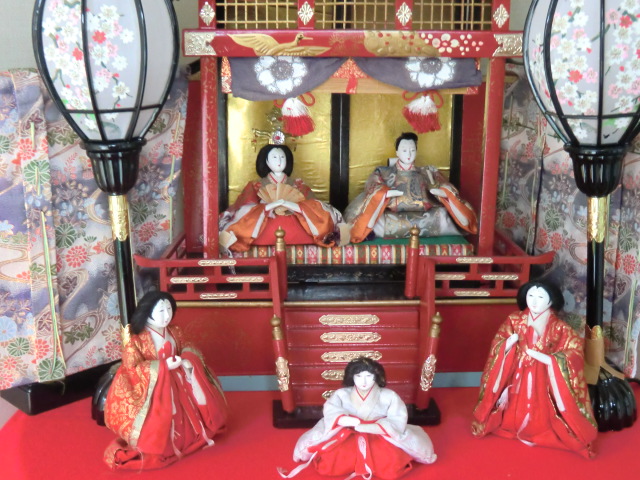
They're"Hina-Ningyo". I happened to see them in Nara,on this March.
People use bamboo to display these dolls.
This style of Hina-Ningyo dispray is not always seen in Japan, 
I think this kind of display is rare in Japan,but it's interesting.

They're tiny and cute...

This is an ancient kimono.

These are balls of cotton wound tightly around with threads of many colors for bouncing.


The two people(on the top shelf) are emperor and empress.
The three women are servants.
This is one of typical way of dispray.

This is also emperor and empress,and their servant.

These dolls are also disprayed.
This girl is carrying a balance.

This doll has a hat decorated with wisteria. 

You can see these Hina-Ningyo in Takatori,Nara,on March,(March 1ーMarch 31)
This is an annual event in Takatori,Nara, and every year,many tourists visit to enjoy this event.

Wednesday, June 15, 2011

Aoi-Festival (masquerade parade) Kyoto (葵祭)

"Aoi-matsuri" is known as  most graceful and elegant festival in Japan.
This is like"masquerade parade",
everyone disguise themselves as nobles in Heian era,
and they march along the main street.They're about 500 people.
They recreate the 9th-century Japanese aristcrat people and their culture.

The origin of this festival dates back 1400 years ago,
Bad weather and bad harvest caused people great distress,
so  they prayed to God, and they had a  horse race,
and the wind and rain died down suddenly.....
And they had a good crop,and they recovered peace and quiet.
This is the origin of this festival.
People in Kyoto has maintained this traditional festival faithfully.
   
 This man disguise himself as an aristcrat in Heian era.

This is an ox-drawn carriage,used by nobles in the Heian era.

These kids are also marching,wearing colourful ancient clothes.

This is a portable shrine,only for noble person. 
This flower umbrella is believed to protect people from evil.
This man disguise himself as an imperial bodyguard.
He carries arrows on his back.
He is in a very good mood (^_^)